What Really Happens at a Dental Exam (And Why It Matters More Than You Think)
For a lot of people, the dental exam is the part of the appointment they pay the least attention to. You open wide, the dentist pokes around for a few minutes, says everything looks fine, and then the hygienist takes over for the cleaning. Simple enough. But what's actually happening during those few minutes is far more involved than most patients realize — and what gets found, or missed, in that window can have a significant impact on your long-term health and your wallet.
At Smile More Nahhas Dental, we believe an informed patient is a healthier patient. So let's walk through what a thorough dental exam actually involves, what we're looking for, and why coming in consistently every six months is one of the smartest investments you can make in your overall wellbeing.
1. It's Not Just About Your Teeth
When Dr. Nahhas begins an exam, teeth are actually just one part of a broader evaluation. A comprehensive dental exam includes a careful assessment of your gums, jaw joint, bite, soft tissues, tongue, and throat. Each of these areas can reveal important information about your oral health — and sometimes about your general health as well.
Gum tissue, for example, tells a story that teeth alone cannot. Inflammation, recession, or pocketing between the gum and tooth can indicate early-stage periodontal disease — a condition that, if left untreated, can lead to bone loss and tooth loss over time. Research has also established connections between gum disease and systemic conditions including heart disease and diabetes, which is why a thorough periodontal evaluation is a non-negotiable part of every exam at our practice.
The jaw joint — the temporomandibular joint, or TMJ — is another area that often goes unexamined at practices focused purely on teeth. Dr. Nahhas checks for clicking, popping, or restricted movement that could indicate early TMJ dysfunction. Caught early, these issues are far easier to manage. Left unaddressed, they can progress into chronic jaw pain, headaches, and even damage to tooth structure from the forces of clenching and grinding.
2. The Role of X-Rays in Catching What Eyes Can't See
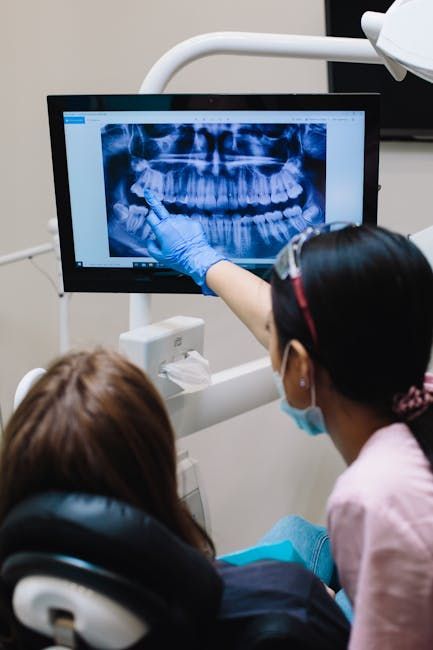
One of the most important tools in any dental exam is also one of the least glamorous: the X-ray. Digital X-rays give us a view of what's happening between teeth, beneath the gumline, and inside the bone — areas that are completely invisible to the naked eye during a visual exam. Without them, a cavity forming between two teeth or bone loss developing below the gumline can go entirely undetected until it becomes a much more serious problem.
We use digital X-rays at our practice, which emit significantly less radiation than traditional film X-rays — roughly 80 to 90 percent less — while producing sharper, more detailed images. For most adults, we recommend bitewing X-rays once a year and a full-mouth series every three to five years, depending on individual risk factors. Patients with a history of cavities or periodontal disease may benefit from more frequent imaging.
X-rays can also reveal things that have nothing to do with cavities. Cysts, tumors, impacted teeth, and bone abnormalities are all detectable on dental X-rays. In some cases, a routine exam has been the first point at which a more serious condition was identified and referred for further evaluation. This is another reason why skipping your exams — even when you feel fine — is a risk that simply isn't worth taking.
3. The Six-Month Rule — And Why It's Not Arbitrary
Most patients know they're supposed to come in every six months, but fewer know why that interval specifically. The answer comes down to biology. The bacteria that cause dental decay and gum disease are constantly active in your mouth. Even with excellent home care, calculus — hardened tartar — begins to accumulate in areas a toothbrush and floss can't fully reach. At roughly six months, this buildup reaches a point where professional intervention is needed to prevent it from triggering more significant problems.
Six months is also the window within which most cavities can be identified and treated at their earliest, most manageable stage. A cavity caught in its earliest phase can often be treated with a small, minimally invasive filling. That same cavity, left undetected for a year or more, may have progressed into the inner layers of the tooth — requiring a crown, or in the worst case, a root canal. The difference in treatment complexity, cost, and recovery is enormous. Prevention isn't just good practice; it's good economics.
At Smile More Nahhas Dental, we make every effort to ensure your exam is thorough, efficient, and genuinely useful to you. We'll walk you through what we find, show you the X-rays, and explain any concerns in plain language — no jargon, no unnecessary alarm. We want you to leave every appointment with a clear understanding of your oral health and a confident plan for maintaining it. If it's been a while since your last exam, there's no better time to come in than now. Your future self will thank you.
Recent Posts